
YUFE Approach to Doctoral and Postdoctoral Learning
At YUFE, we are building a shared vision for European education by supporting doctoral and postdoctoral researchers with unique training models and career development opportunities.
Integrating doctoral and postdoctoral training with YUFE values, such as responsible research, is a key element of this vision for joint European education. This will be achieved through a comprehensive doctoral and postdoctoral training model and tracking framework designed to promote responsible research practices actively.
With this approach, YUFE piloted several initiatives to support early-career researchers:
- YUFE DIOSI Model for Doctoral Learning
- YUFE Postdoctoral Training and Development Scheme
- YUFE DIOSI Impact and Graduate Tracking Framework
- YUFE Courses for Early Career Researchers
- Framework for Joint Supervision and Mentoring
YUFE Pilot Projects for Early Career Researchers

The YUFE DIOSI Model for Doctoral Learning
In the DIOSI project, the YUFE DIOSI Model for Doctoral Learning was created coming to terms with doctoral learning in a changing higher education environment where a failure to adjust the entrance to workforce to the slowing expansion of the research system has led to an overproduction of aspiring scientists with limited opportunities for permanent careers in academia.
These evolutions have had a crucial impact on the doctoral experience where doctoral education in Europe has evolved from serving a calling in academia and developing into competitive researchers to also become highly-skilled knowledge professionals with transferrable competence-based profiles. This evolution has not resulted in any convergence of views or solutions and a wide variety of doctoral experience still exists today.
Therefore, a vision was developed for the future of doctoral learning, and a joint model of doctoral learning, finding itself at the crux between research, education, and innovation, was explored.
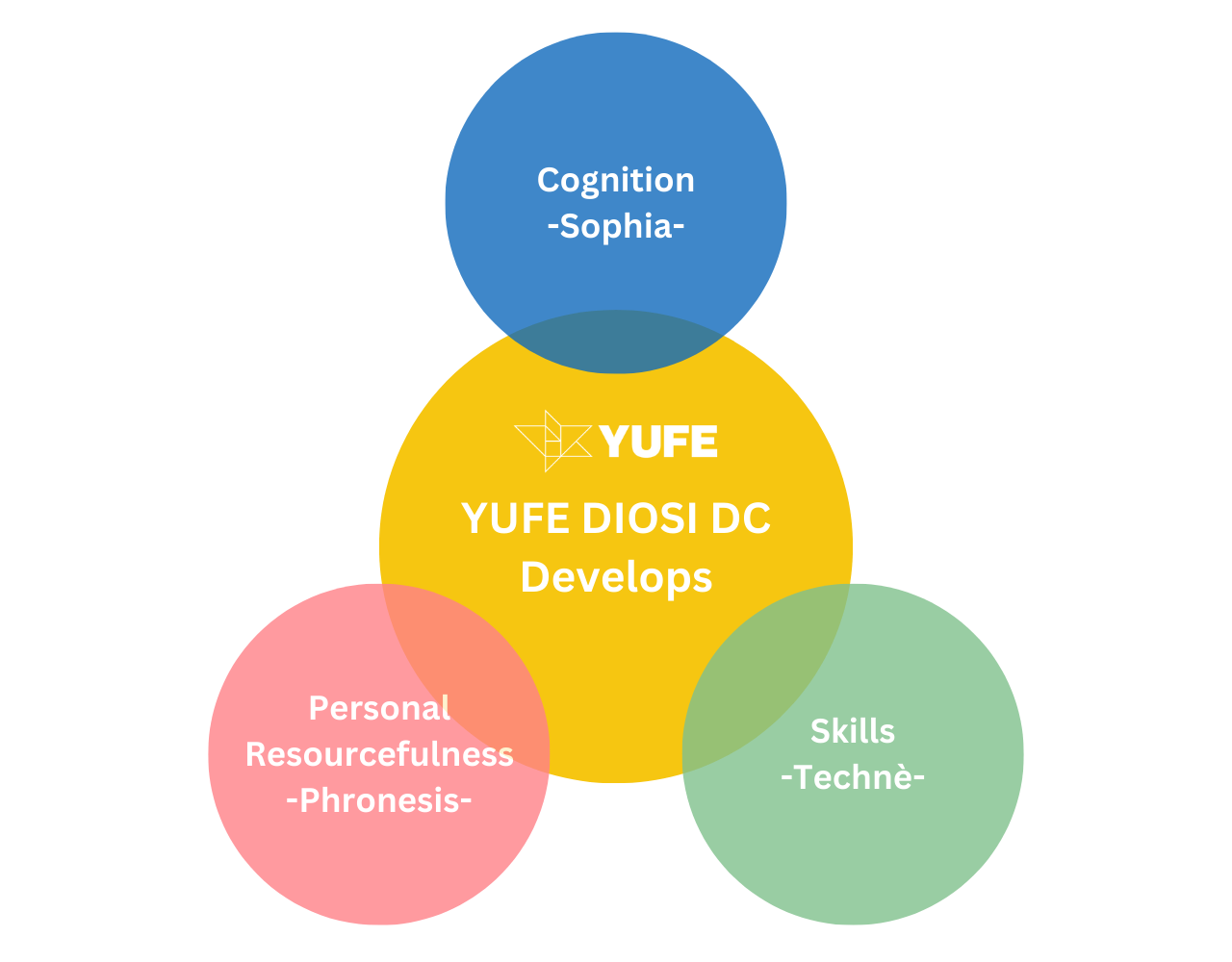
The new YUFE DIOSI Model was thus defined based on this analysis and contains five principles:
- A joint vision on doctoral learning with three main desired outcomes for a YUFE DIOSI PhD holder (1)
- An overarching framework for the doctoral programme that acknowledges diverging expert visions on the ideal learning format(s) for the doctorate, which includes:
- transferrable skills training (2)
- formal and informal learning (3)
- an extended thesis reflection (4)
- a strategic reframing of supervisory relationships (5)
Bibliography
This webpage builds on previous work by authors in non-peer reviewed outlets. We reuse (parts of) texts published in Kersschot, 2021 (DOI: 10.5281/zenodo.7300114), and Golob, Künn-Nele, Sušanj, Zubić, Zelenika, 2022 (10.5281/zenodo.7351179).
Mowbray, S. & Halse, C. (2010) The purpose of the PhD: theorising the skills acquired by students, Higher Education Research & Development, 29:6, 653-664, DOI:10.1080/07294360.2010.48719
The completion of the YUFE Pilot on Doctoral Learning and the YUFE Pilot on Postdoctoral Training and Development marks an important step towards a shared European vision on early career researcher support. The insights gained during these pilots form the foundation for future YUFE-wide and institutional initiatives.
News
The YUFE pilot programmes have been successfully completed. Below are some highlights and outcomes.
The YUFE Pilot on Postdoctoral Training and Development concluded on 19 January 2026 with the closing event Connect & Reflect, bringing together postdoctoral researchers and staff from across the YUFE alliance. The event focused on reflection, networking and shaping the future of postdoctoral development within YUFE, and featured a keynote by Dr. Ira Virtanen on the power of networking, followed by an interactive session for participants to exchange experiences and insights.
The YUFE Pilot on Doctoral Learning concluded on 14 January 2026 with the closing event From Reflections to Directions, bringing together doctoral researchers and staff from across the YUFE alliance. The event focused on reflecting on PhD experiences, exploring diverse career paths, and shaping the future of doctoral training within YUFE. Highlights included career insights from doctoral graduates, emphasizing transferable skills, strategic thinking, and communicating research beyond academia, as well as discussions on peer challenges and mentoring.
The University of Antwerp successfully completed its non-academic mentoring programme as part of the YUFE Pilot on Doctoral Learning.
From September 2024 to September 2025, the programme connected doctoral researchers with mentors from diverse professional backgrounds. Its goal: to support both career and personal growth.
At the closing event, participants shared inspiring testimonials. The key takeaway was clear: mentoring fosters growth in perspective, confidence, career development, and connection between academia and the wider world.
The 13 trained Peer Support facilitators have successfully launched 11 Peer Support groups in the spring of 2025, an incredible achievement in supporting the needs of postdoctoral research communities across the YUFE Alliance. With 117 participants actively engaged, these groups are thriving. The feedback has been incredible, and the energy from participants has been nothing short of inspiring.
On November 19th 2024, the YUFE Pilot on Postdoctoral Training and Development started with a YUFE-wide virtual kick-off across all the YUFE institutions. We will be piloting the YUFE Pilot on Postdoctoral Training and Development Scheme until end 2025, with international YUFE wide high quality training and peer networking opportunities, focusing on postdoctoral researchers as a distinct target group that merit specific attention.
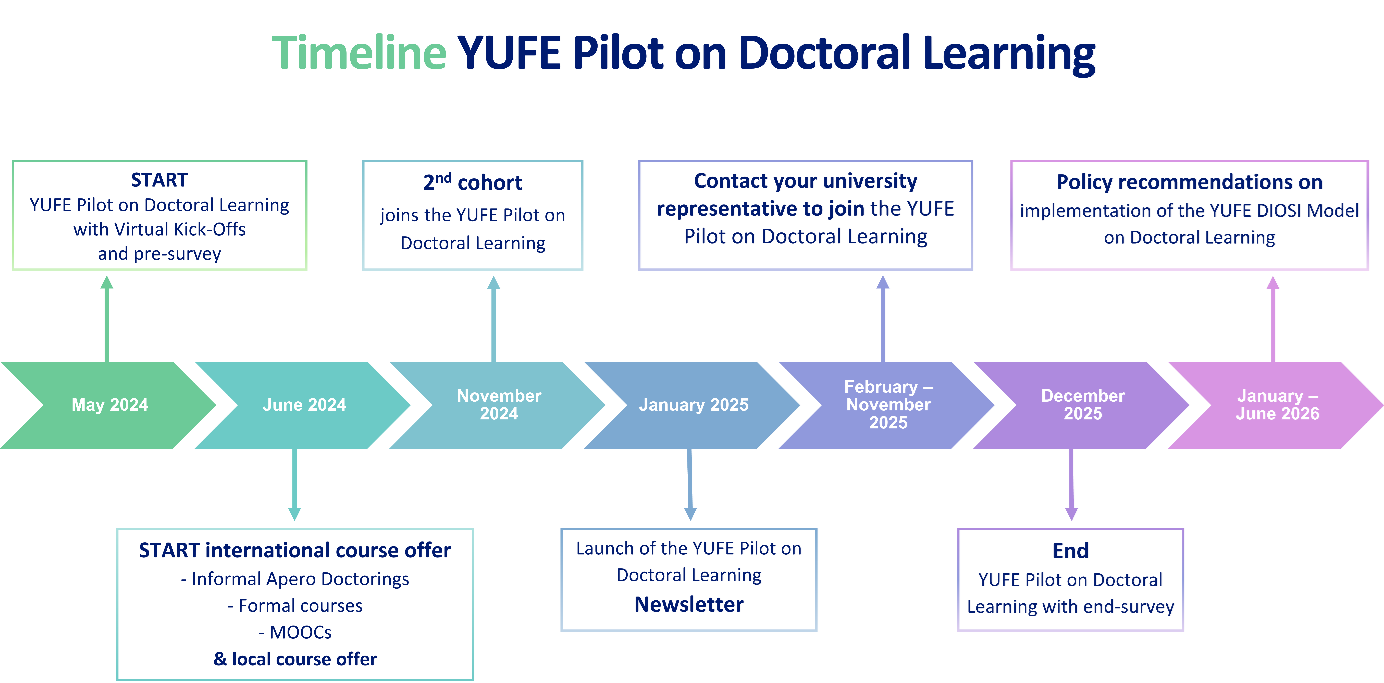
On May 7th 2024 the YUFE Pilot on Doctoral Learning started with a YUFE-wide kick-off across all 7 participating YUFE institutions. We will be piloting and implementing the YUFE DIOSI Model for Doctoral Learning until end 2025 and based on an elaborate evaluation at the end, specific recommendations will be formulated to help other institutions with further implementation of the YUFE DIOSI Model for Doctoral Learning.
The DIOSI project developed by the YUFE alliance has received its review from the European Research Executive Agency of the European Commission. They state that the project has delivered exceptional results with significant immediate or potential impact. For more information you can click here.
