
3 July 2026
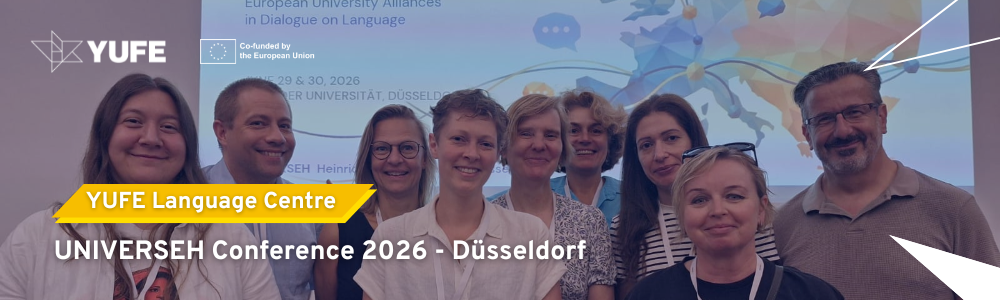
The YUFE Language Centre 3.5 Taskforce took part in the UNIVERSEH Conference 2026, “No Language, No Alliance: European University Alliances in Dialogue on Language”, hosted by Heinrich Heine University Düsseldorf on 29 and 30 June 2026.
The conference brought together participants from 19 European university alliances and 54 different cities to discuss multilingualism, language policy, communication practices and the role of languages in international higher education cooperation. Its title captured one of the central challenges of European university alliances: cooperation depends on communication, and communication depends on language choices.
YUFE made a strong contribution to the event, with three presentations included in the programme. The YUFE Language Centres 3.5 taskforce was represented by nine colleagues from seven YUFE partner universities: the University of Antwerp, Sorbonne Nouvelle, the University of Eastern Finland, Nicolaus Copernicus University in Toruń, the University of Bremen, the University of Cyprus and the University of Rijeka.
A key theme throughout the conference was the role of English in multilingual alliances. Participants discussed the dilemma of English as both a dominant language and a practical working language. While English may be perceived as a threat to multilingualism if it replaces other languages, it can also serve as an efficient and inclusive tool for international teaching, cooperation and participation.
For YUFE language centres English represents a gateway to inclusion. In the YUFE context, English is often the first language that enables students, teachers, researchers and administrative staff to take part in international cooperation. It opens access to mobility, joint learning, COIL activities, staff collaboration and alliance-level communication.
At the same time, English is not the final goal of multilingualism. Rather, it can be the first step towards deeper multilingual engagement. Once cooperation is made possible through a shared working language, alliance members can create further opportunities to learn, use and value the languages of partner universities. This makes YUFE’s approach to multilingualism pragmatic and inclusive: English opens the door, while other languages strengthen intercultural understanding, belonging and engagement with local academic communities.
The conference highlighted the strategic role of language centres in European university alliances. By supporting communication, intercultural preparation, student and staff development, they help turn multilingualism from an idea into everyday practice. The participation of YUFE colleagues in Düsseldorf reinforced a simple but important message: without language, there is no alliance, and without languages, there is no truly multilingual European academic community.