
24 July 2026
The European Universities Initiative has become an important driver of closer cooperation in European higher education.
Currently, 73 alliances bring together almost 650 higher education institutions, creating new opportunities for students and staff to learn, teach and collaborate across national and institutional boundaries.
As these alliances move beyond their initial experimental phase, an important question is becoming increasingly relevant: how can we understand what works within these alliances, under which conditions, and how can their impact be maximised?
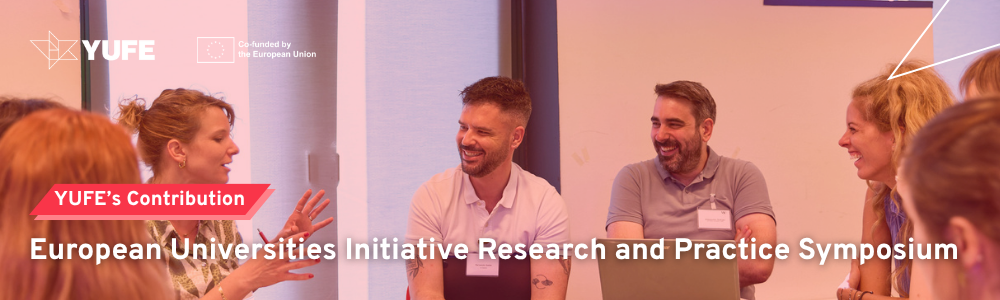
The 2nd European Universities Initiative Research and Practice Symposium, held on 2nd–3rd July 2026 at the Vienna University of Economics and Business (WU Wien), addressed this question through the concept of practice-informed research. The symposium created a space where evidence, research methods and theoretical perspectives could connect with the practical experience of designing, managing and developing European University alliances. The event brought together 90 participants from 18 countries, representing 32 alliances. 42 paper presenters were given, addressing five broad themes: alliance identity and purpose, implementation and governance, the transition from experimentation to more sustainable structures, evidence and methodology, and future political scenarios. This diversity was also reflected in the participants themselves, who came from academic, professional and student communities across European University alliances.
Discussions explored questions such as how alliances change universities, how students can play a meaningful role in their development, and how long-term institutional and educational change can be assessed without reducing it to a narrow set of indicators.
YUFE’s Contribution
YUFE contributed to the symposium through a paper presentation and a poster presentation, addressing two distinct but complementary dimensions of alliance development. Ana Tomaško Obradović (University of Rijeka), together with Aleksandar Šušnjar (University of Rijeka / EQAR), presented the paper “Complement or Complication? Convergences and Divergences between the European Degree Label and the European Approach for QA of Joint Programmes”.
The European Degree Label initiative aims to recognise joint study programmes that meet a shared set of European criteria and make their transnational character more visible and recognisable. As the initiative moves from piloting and preparation towards full roll-out, its Operational Guide builds, where possible, on existing quality assurance procedures for joint programmes. The presentation examined how this connection works in practice by looking at evidence for
selected label criteria in European Approach accreditation reports and using the YUFE Joint Bachelor programme in Urban Sustainability Studies as an in-depth case study.
The analysis pointed to several practical considerations for joint programme consortia and other stakeholders involved in implementing the European Degree Label. Nicholas J. Bradshaw (University of Rijeka) meanwhile presented the poster “Grassroots Initiatives within a Formal European University Alliance: A Case Study of BioYUFE”. BioYUFE is a grassroots/bottom-up group that has developed over the past several years out of a group of staff, both academic and administrative, in the various life science-related faculties of the YUFE alliance, as well as increasingly moving into transdisciplinary work.
Through online elective courses, webinars and regular meetings, the initiative has created new opportunities for international teaching and collaboration. The case study highlighted the importance of seed funding, institutional recognition and continued support in helping grassroots initiatives develop and remain sustainable.
YUFE’s two contributions reflected two sides of alliance development: building the structures needed for joint European education and creating the conditions in which new forms of cooperation can grow from the bottom up.