23 February 2026
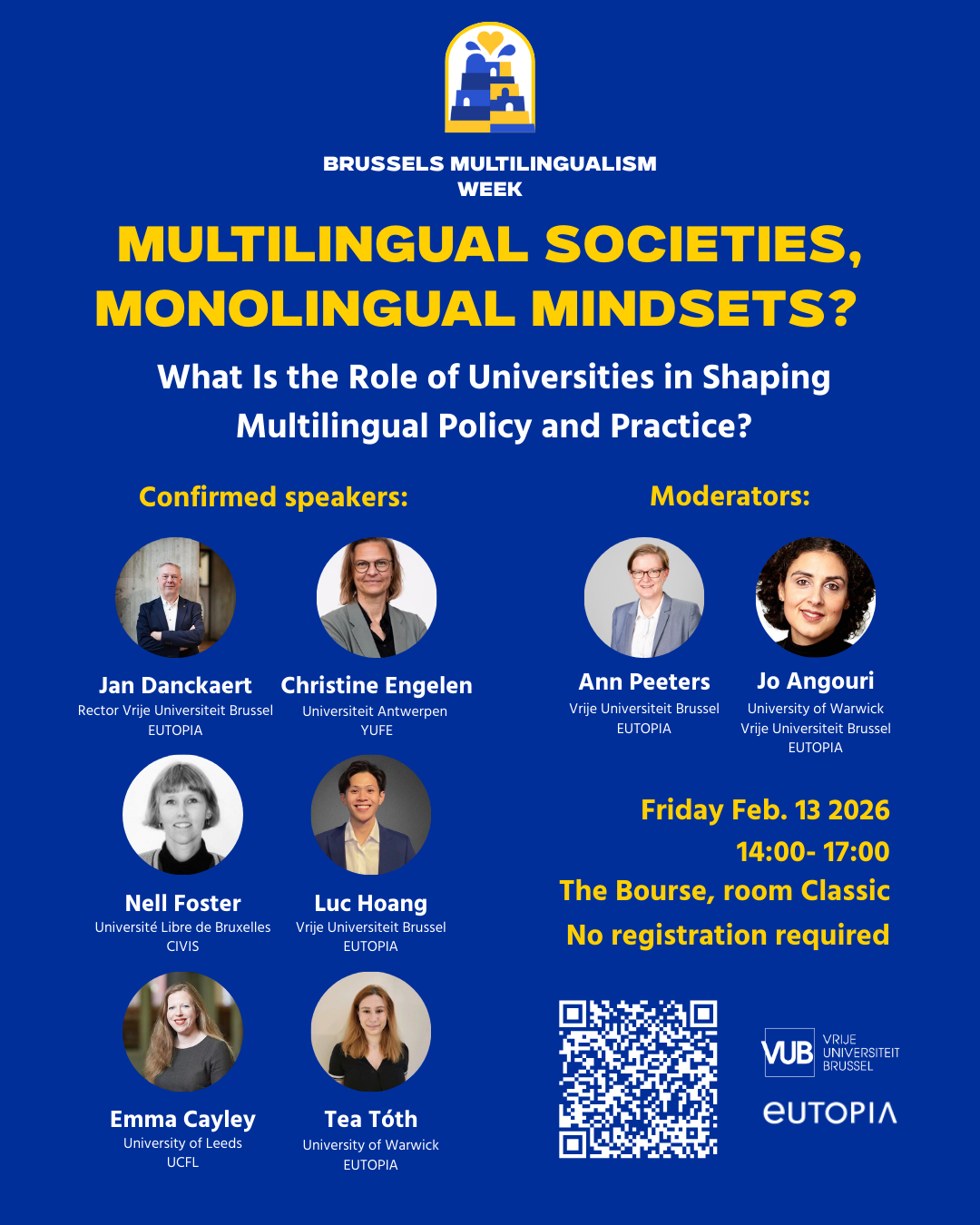
Looking back at the public debate “Multilingual Societies, Monolingual Mindsets? What is the Role of Universities in Shaping Multilingual Practice Policy and Practice?”, 13 February 2026
During Brussels Multilingualism Week, Christine Engelen represented both the University of Antwerp and YUFE in a public debate titled ‘Multilingual Societies, Monolingual Mindsets?’. On Friday 13 February 2026, she joined colleagues from Belgian and UK universities, including representatives of the European University Alliances EUTOPIA and CIVIS, to reflect on the growing disconnect between multilingualism as a lived European reality and the predominantly monolingual (or bilingual) norms that characterise higher education.
While multilingualism is widely celebrated as a cornerstone of European culture, and while many people navigate multilingual and superdiverse environments in their daily lives, these dynamics remain poorly reflected in university policies and practices. This gap not only frustrates those committed to linguistic diversity but also creates structural tensions within institutions.
Multilingualism at University Level
With a room filled largely with young participants, the discussion first turned to the situation within universities themselves. What practices currently support or hinder multilingualism? And which strategic decisions could ensure that linguistic diversity remains or becomes an integral part of institutional missions?
Differences between institutions surfaced quickly. Some universities operate under strict legal requirements, while others have no formal language policies as such. Several participants described a strong appetite among students for multilingual and multicultural activities, contrasted with “cold spots” where universities in parts of the UK offer no language degrees anymore. Meanwhile, institutional responses vary widely: some universities invest in student language support, while others prioritise helping staff transition to English-Medium Instruction (EMI).
Multilingualism Across Alliances
The second part of the discussion focused on European university alliances. What are the current practices and pilots put in place to make multilingualism reality, beyond traditional mobility and language learning? What future strategies should be pursued to embed multilingualism structurally? Several promising practices emerged: multilingual BIP programmes extending beyond English; efforts to bring multilingualism into the awareness of stakeholders outside language departments; and the growing role of technology in enabling the use of multiple languages in teaching and learning.
A clear statement also advocated that we need to shift our thinking from language learning to language use, especially in times when technology progressively supports the acquisition process. Speaking for YUFE, Christine Engelen noted that English proficiency at B2 level currently serves as an entry requirement for the different educational programmes. To support greater inclusivity, YUFE is exploring new initiatives to strengthen English proficiency among local students. In this sense, English serves as a stepping stone towards broader multilingual engagement across the alliance.
A Student’s Perspective
YUFE Student Forum member and UAntwerp student Elisa Mames Antuna also attended the event. She emphasised how illuminating it was to see the diverse approaches to multilingualism across universities and alliances. Creative practices spark new ideas, while differences in regulation and regional context explain why some institutions remain structurally monolingual (or bilingual) despite their ambitions. A key takeaway here is that English could be used as a bridge towards multilingualism throughout alliances. Her student eye also caught the funding issue for all universities across Europe, and how it impacts languages and education.
Looking Ahead
The panel’s reflections made one point clear: English is unlikely to disappear from European higher education, but it does not need to dominate at the expense of other languages. Used strategically, it can function as a bridge rather than a barrier, opening doors to more inclusive, sustainable multilingual practices. The challenge now is to turn that potential into institutional reality.
Background info
The first Brussels Multilingualism Week took place from Monday 9 to Saturday 14 February 2026, on the initiative of the Brussels Council for Multilingualism and in collaboration with the Brussels-Capital Region. Activities took place throughout the entire week across the Brussels-Region, culminating in a closing day at the Palais de la Bourse on February 14th.
Participants: Ann Peeters (Vrije Universiteit Brussel, EUTOPIA), Jo Angouri (University of Warwick, VUB, EUTOPIA), Jan Danckaert (Rector Vrije Universiteit Brussel, EUTOPIA), Christine Engelen (Universiteit Antwerpen, YUFE), Nell Foster (Université Libre de Bruxelles, CIVIS), Luc Hoang (Vrije Universiteit Brussel, EUTOPIA), Emma Cayley (University of Leeds, UCFL), Tea Toth (Universite of Warwick, EUTOPIA)
Read more about Multilingualism at YUFE +